Part I: The Scale of the Endowment
The numbers require careful framing. Sub-Saharan Africa has an estimated 350 GW of technically feasible hydropower potential according to the International Renewable Energy Agency (IRENA). Of this, approximately 37 GW is currently installed: an 11% utilization rate. Europe, by contrast, has installed approximately 220 GW against a technically feasible potential of 340 GW, a 65% utilization rate. This comparison is not an argument for building every feasible dam. Many sites involve unacceptable social or ecological costs. It is a statement about the scale of the gap between what exists and what has been built, and therefore about the scale of the opportunity for nations willing to develop it deliberately.
Part II: The Grand Ethiopian Renaissance Dam
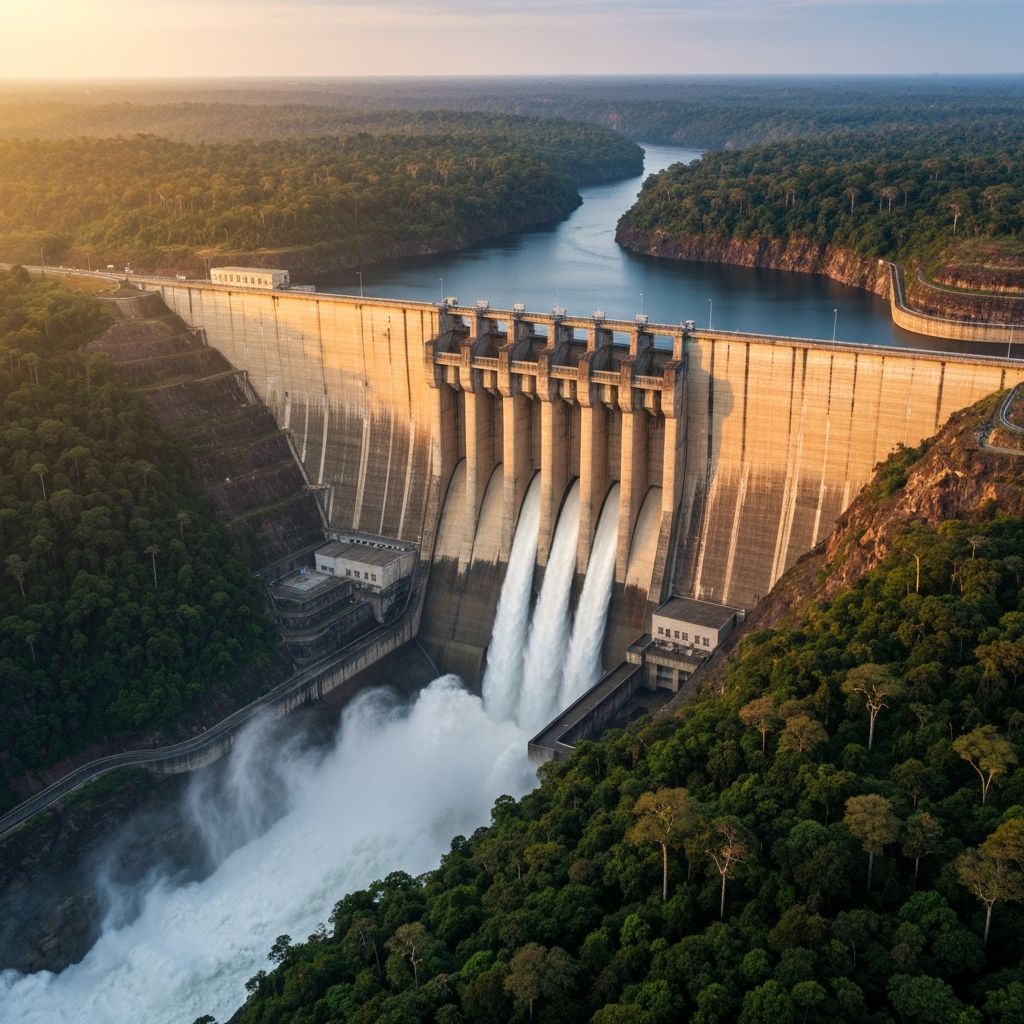
The GERD reached full operational capacity of 5,150 MW in April 2024, after a construction period that began in 2011. It is the most significant infrastructure project in Ethiopia's history and a deliberate statement of energy sovereignty. Ethiopia's Industrial Parks Development Corporation has already begun positioning the country as a manufacturing hub partly on the basis of electricity cost advantages. Industrial electricity in Ethiopia is priced at approximately $0.02 to $0.03 per kWh for qualifying industrial users, among the lowest of any African economy. The African Development Bank estimates that Ethiopia's GDP growth is projected at 7.2% for 2025, supported significantly by expanded electricity access enabling industrial productivity. The strategic question for Ethiopia is whether to extend this model into digital infrastructure. Addis Ababa's climate (2,355 metres above sea level, average temperature 16 degrees Celsius) provides ambient cooling conditions directly comparable to Nepal's mid-Himalayan zones. A data centre in Addis Ababa would achieve cooling efficiencies unavailable at sea level. The city is connected by fiber to Djibouti and onward to the SEACOM and EASSy cables serving East African coastal connectivity. Latency from Addis Ababa to Dubai is approximately 40 ms; to London approximately 90 ms.
Part III: Inga and the DRC
The Democratic Republic of Congo's Inga site on the Congo River represents the largest single hydropower development opportunity in the world. The Congo River discharges approximately 41,000 cubic metres per second, the second-highest flow rate of any river on Earth after the Amazon. Inga 1 (351 MW, commissioned 1972) and Inga 2 (1,424 MW, commissioned 1982) are currently operational, though both operate well below nameplate capacity due to maintenance deficits. Inga 3, a 4,800 MW expansion, received a revised development framework in 2021 after years of failed procurement processes. Grand Inga, the full site development, would represent 44,000 MW of capacity at full build-out, more than South Africa's entire current electricity generating capacity. The DRC's electricity generation potential is sufficient to power the entire African continent. The obstacle is not energy. It is governance, capital, and grid infrastructure. Any realistic path to Inga development runs through a combination of multilateral development bank financing, sovereign wealth fund participation, and anchor off-take agreements from a combination of domestic industry, regional grid export, and potentially large-scale digital infrastructure.
Part IV: The Digital Infrastructure Case
The case for directing a portion of East Africa's expanding hydropower capacity toward digital infrastructure rather than routing it entirely toward household electrification and grid export rests on the value multiplier argument. Grid electricity exported at commodity prices earns $0.02 to $0.04 per kWh. The same electricity, converted to AI compute services, earns the equivalent of $0.20 to $0.40 per kWh in effective revenue. The ten-to-twenty-fold multiplier applies across the full range of high-value compute workloads: AI training, inference serving, Bitcoin mining, and scientific compute. Ethiopia's altitude and climate, the DRC's electricity cost structure, and Uganda's position at the northern end of the Nile Basin each offer specific competitive advantages. None of these translate automatically into investment. They require: clear sovereign digital infrastructure policy; anchor tenants (government, regional development banks, or an early-mover hyperscale operator); subsea cable connectivity enhancement; and the institutional frameworks to protect investor rights and data sovereignty simultaneously.
Key Takeaways
- 1Sub-Saharan Africa has 350 GW of technically feasible hydropower, of which only 11% is developed
- 2Ethiopia's GERD reached 5,150 MW operational capacity in 2024; industrial electricity costs $0.02-$0.03/kWh
- 3The DRC's Inga site represents 44,000 MW of potential: the largest single hydropower development opportunity on Earth
- 4Addis Ababa at 2,355m provides natural cooling comparable to Nepal's mid-Himalayan zones
- 5The value multiplier: electricity exported at $0.03/kWh versus AI compute revenue equivalent of $0.20-0.40/kWh