Part I: The Physics of Advantage
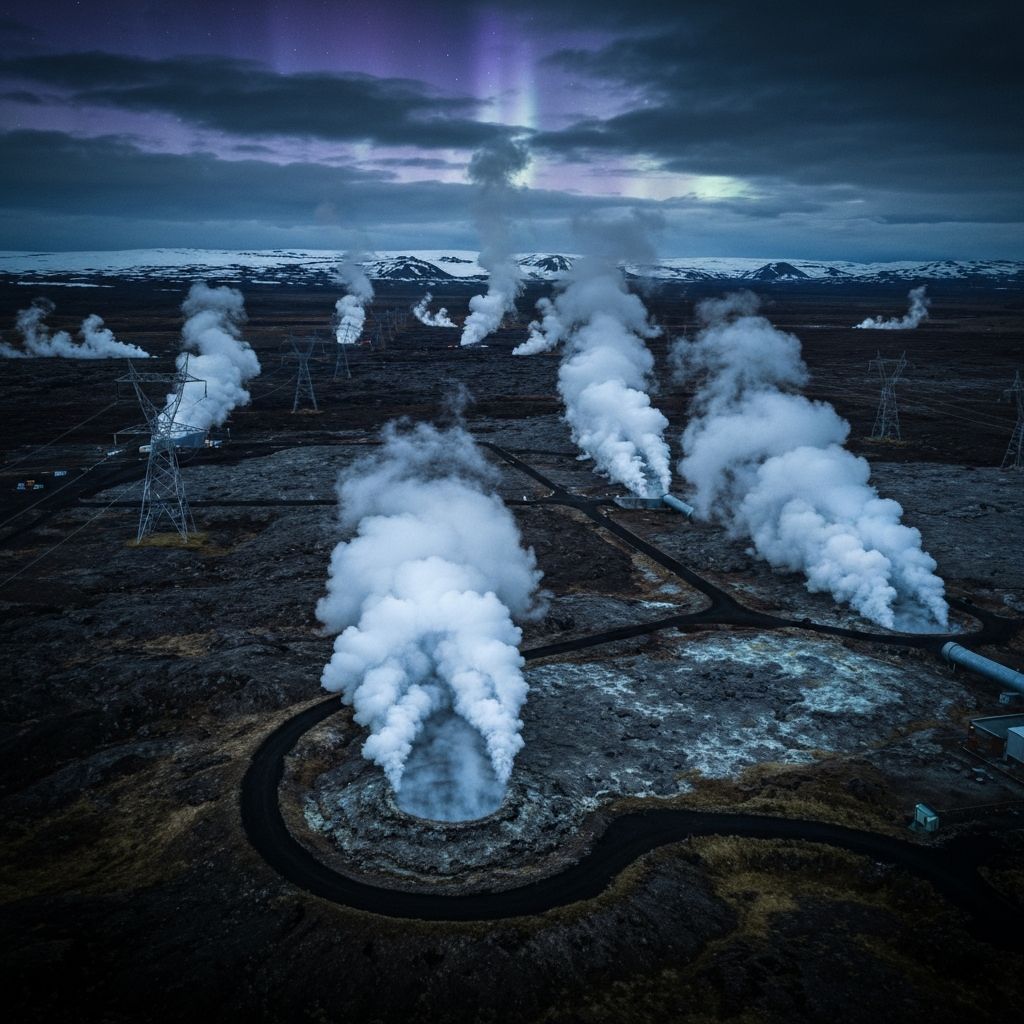
Data centres have two dominant operating costs: electricity for computation, and electricity for cooling. In conventional locations, cooling accounts for 30 to 50% of total energy consumption. In Iceland, this cost approaches zero. The arctic climate eliminates the need for mechanical cooling systems entirely across most of the year. Geothermal electricity costs $0.03 to $0.05 per kWh for industrial consumers. A hyperscale data centre consuming 100 MW of power spends approximately $26 million per year on electricity in Iceland versus $70 million in Frankfurt, $88 million in London, or $61 million in Dublin. The differential across a 10-year asset life is $350 million to $620 million per facility. This is not a marginal advantage. It is a structural cost gap that compounds as facilities scale.
Part II: What Iceland Has Built
Iceland's data centre sector began with Verne Global, which in 2012 converted a former NATO base at Keflavik into one of Europe's first purpose-built renewable-powered data centres. Today the country hosts facilities operated by or serving Advania, Borealis Data Centre, atNorth, and a growing list of hyperscale operators running Nordic edge nodes. Bitcoin and digital asset mining has been a significant part of the picture: at peak, Iceland was hosting an estimated 0.5% of the global Bitcoin hashrate from a nation with 0.005% of the world's population. The sector currently employs approximately 1,500 people directly and generates revenues estimated at 2 to 3% of GDP, a significant proportion for a small economy. The government's approach has been characterized by active facilitation rather than passive permitting: dedicated industrial energy tariffs for qualifying data infrastructure, streamlined planning permissions, and explicit inclusion of digital infrastructure in national energy policy documents.
Part III: Sovereign Policy as Multiplier
The lesson from Iceland is not simply that geothermal energy is valuable. It is that the value of an energy endowment depends almost entirely on the policy architecture built around it. Iceland's government made three decisive choices that compounded the natural advantage. First, it created industrial electricity tariffs specifically calibrated for compute-intensive industries, providing price certainty over multi-year contract periods. Second, it treated data centres as strategic national infrastructure, applying the same regulatory facilitation that the country extends to aluminium smelters and major industrial projects. Third, it invested in subsea cable connectivity: Iceland is now connected to Europe via the FARICE-1 and DANICE cables, and to North America via AEConnect. The result is that Iceland's geographic isolation, historically a constraint, has become an asset: its data centres are jurisdictionally independent, politically stable, geologically resilient, and fully connected.
The analogy to Nepal, Bhutan, and the East African hydropower corridor is direct. The physics of the advantage differs (geothermal versus hydroelectric, arctic cooling versus high-altitude cooling) but the structural logic is identical: renewable electricity at cost structures below $0.05/kWh, combined with natural thermal environments that eliminate cooling overhead, produce data centre operating economics that conventional geographies cannot match. What Iceland demonstrates is that the policy and infrastructure investment required to unlock this advantage is modest relative to the returns.
Key Takeaways
- 1Iceland generates 100% of electricity from renewable sources at $0.043/kWh for industrial users
- 2PUE of 1.03 versus global average 1.58, entirely from ambient arctic cooling with no mechanical systems
- 3The policy architecture matters as much as the physical endowment: industrial tariffs, streamlined permits, subsea cable investment
- 4Digital infrastructure is now Iceland's fourth-largest industrial sector at 2-3% of GDP
- 5The structural template applies directly to Nepal, Ethiopia, and any nation combining low-cost renewables with natural cooling advantages