Part I: The Renewable Electricity Buildout
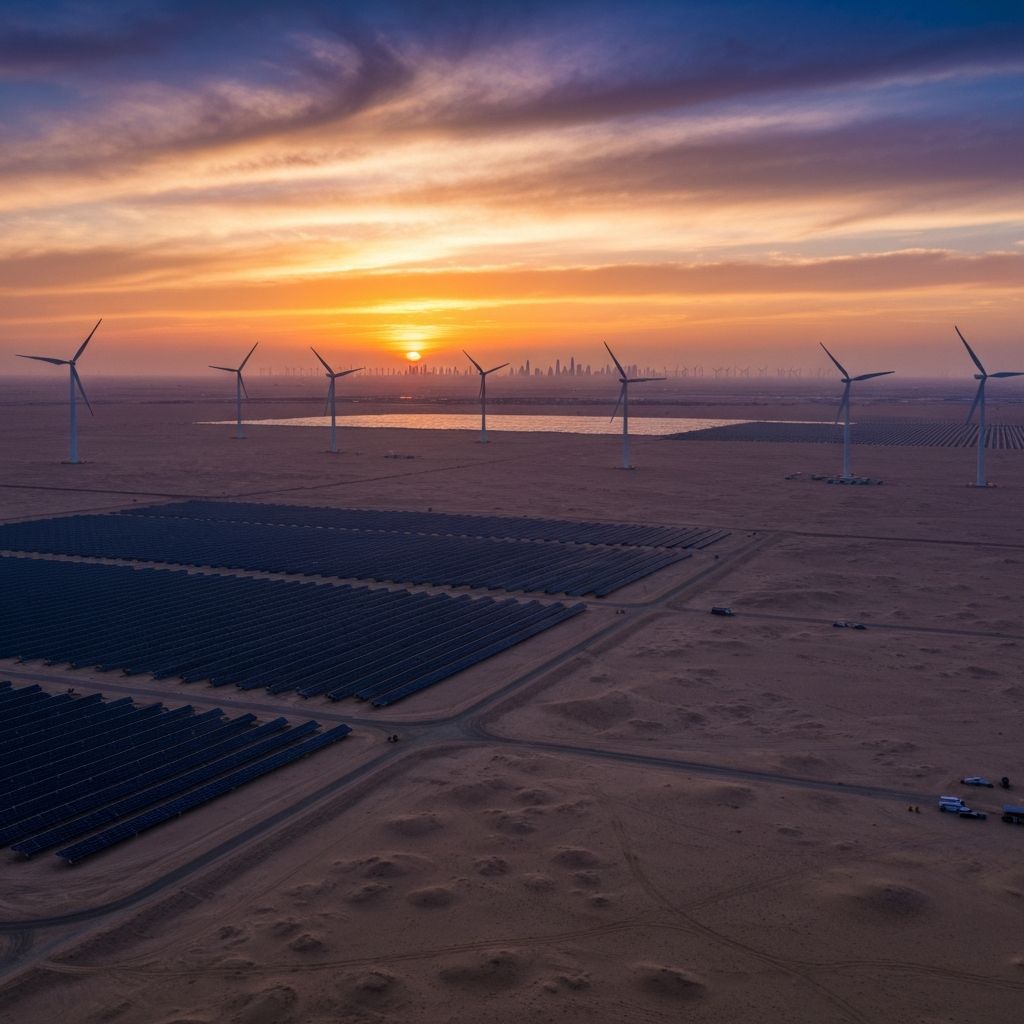
Saudi Arabia's solar irradiance is among the highest on Earth. The country's Najd plateau receives an average of 2,200 to 2,400 kWh of solar energy per square metre per year, comparable to the Atacama Desert in Chile, which hosts some of the world's most productive solar projects. The Saudi government's National Renewable Energy Program has awarded contracts for over 58 GW of renewable capacity as of early 2025, with a pipeline of additional projects targeting 130 GW by 2030. The most significant single project is the Al Shuaiba solar complex, a 2.6 GW photovoltaic installation under construction near Jeddah, which when complete will be the largest single solar facility in the world. Electricity from Al Shuaiba is contracted at $0.0104 per kWh, the lowest power purchase agreement price recorded for a utility-scale solar project anywhere in the world as of 2024 (IRENA, 2025). This matters for digital infrastructure because it establishes a floor price for AI compute electricity in Saudi Arabia that is structurally below any European or North American benchmark.
Part II: NEOM as Digital Infrastructure Platform
NEOM is a $500 billion development project covering 26,500 square kilometres of northwestern Saudi Arabia along the Red Sea coast and into the Hejaz mountains. Its most famous component is The Line: a proposed 170-kilometre linear city that has attracted both widespread attention and significant skepticism. The Line is not, however, the entirety of NEOM's strategic significance. OXAGON, NEOM's industrial and port city on the Red Sea, is designed as the world's largest floating industrial complex and will host the flagship green hydrogen production facility. SINDALAH is a luxury tourism island. TROJENA is a mountain resort designed to host the 2029 Asian Winter Games. The digital infrastructure dimensions of NEOM are less publicised but strategically significant. NEOM's master plan specifies that 100% of the development's energy will come from renewable sources, that the city's operational systems will be managed by an AI operating system, and that data sovereignty will be a foundational design principle. NEOM has signed agreements with Amazon Web Services, Google Cloud, and a consortium of telecommunications companies to establish regional data infrastructure within the development zone. As of 2025, NEOM's data centre development pipeline includes facilities targeting a combined 500 MW of IT load capacity by 2030, powered entirely by solar and wind.
Part III: Green Hydrogen as the Export Bridge
The strategic insight underlying Saudi Arabia's energy transition is that the country's competitive advantage is not oil. It is the ability to produce energy cheaply from its geography. Oil has been the vehicle for that advantage for 80 years. The Vision 2030 hypothesis is that solar-powered green hydrogen can be the next vehicle. NEOM's OXAGON green hydrogen facility, developed through the NEOM Green Hydrogen Company (a joint venture between ACWA Power, Air Products, and NEOM), is targeting production of 600 tonnes of green hydrogen per day by 2030, converted to green ammonia for export. The facility will be powered by 4 GW of dedicated solar and wind generation. At $0.01 per kWh electricity costs, Saudi green hydrogen has a projected production cost of $1.50 to $2.00 per kilogram by 2030, compared to current European electrolytic hydrogen costs of $4.00 to $6.00 per kilogram. This cost differential, if achieved, would represent a structural advantage in the emerging green hydrogen export market comparable to Saudi Arabia's historical advantage in oil. The World Bank projects global green hydrogen trade volumes could reach 150 million tonnes per year by 2050, generating annual revenues comparable to current global LNG trade.
Part IV: The Sovereignty Logic
Saudi Arabia's energy transition is ultimately an exercise in sovereignty extension rather than sovereignty transfer. The country is not replacing oil dependence with renewable dependence. It is building an energy system that it controls: its own solar plants, its own hydrogen facilities, its own data infrastructure, its own digital city. The contrast with the post-colonial energy model, in which natural resource wealth was extracted and value was captured upstream by international operators and financiers, is deliberate and explicit in the Vision 2030 documentation. For other nations with energy endowments, the Saudi case raises a pointed question: who should own the infrastructure that converts natural energy advantage into digital value? Iceland answered this question by attracting foreign operators under sovereign terms. Nepal has not yet answered it. Ethiopia is in the process of formulating an answer. The DRC has been prevented from answering by governance failures that are not inevitable. The Saudi answer is unambiguous: the state, through its sovereign investment vehicles, captures the majority of the value. Whether that model is transferable depends less on the energy endowment than on the institutional capacity to execute it.
Key Takeaways
- 1Saudi Arabia produces 9.6 million barrels of oil per day while simultaneously building 130 GW of renewable capacity by 2030
- 2Al Shuaiba solar complex (2.6 GW) is contracted at $0.0104/kWh: the world record low for utility-scale solar
- 3NEOM's data centre pipeline targets 500 MW of IT load capacity by 2030, 100% renewable-powered
- 4OXAGON green hydrogen targets 600 tonnes per day by 2030 at projected $1.50-$2.00/kg production cost
- 5The strategic logic: translate energy dominance from one era (oil) to the next (solar, hydrogen, compute)